
“This has never happened before, so it’s very exciting,” says Magic the Gathering head designer Mark Rosewater as we start a new round of his upcoming trading card game, Mood Swings. Despite the trading card game being designed to be easy to pick up--as well as Rosewater having played thousands of matches over its nearly 30 years of development--he is about to pull off a very specific sequence of moves for the first time.
On its face, Mood Swings delivers on its promise of being incredibly straightforward. In its primary format, two players (although it can be played with more) each form a hand of five cards from a single 45-card deck. Each card is named after an emotion, has an associated value, and a unique effect, with only one-card-per-person played each round. After every participant completes their turns, whichever person has the highest total value of cards on the table wins the round, and winning three rounds secures victory. Cards in play carry over between rounds, with the winner of the previous round going first, and the loser drawing a new card (more often than not, going second is advantageous.)
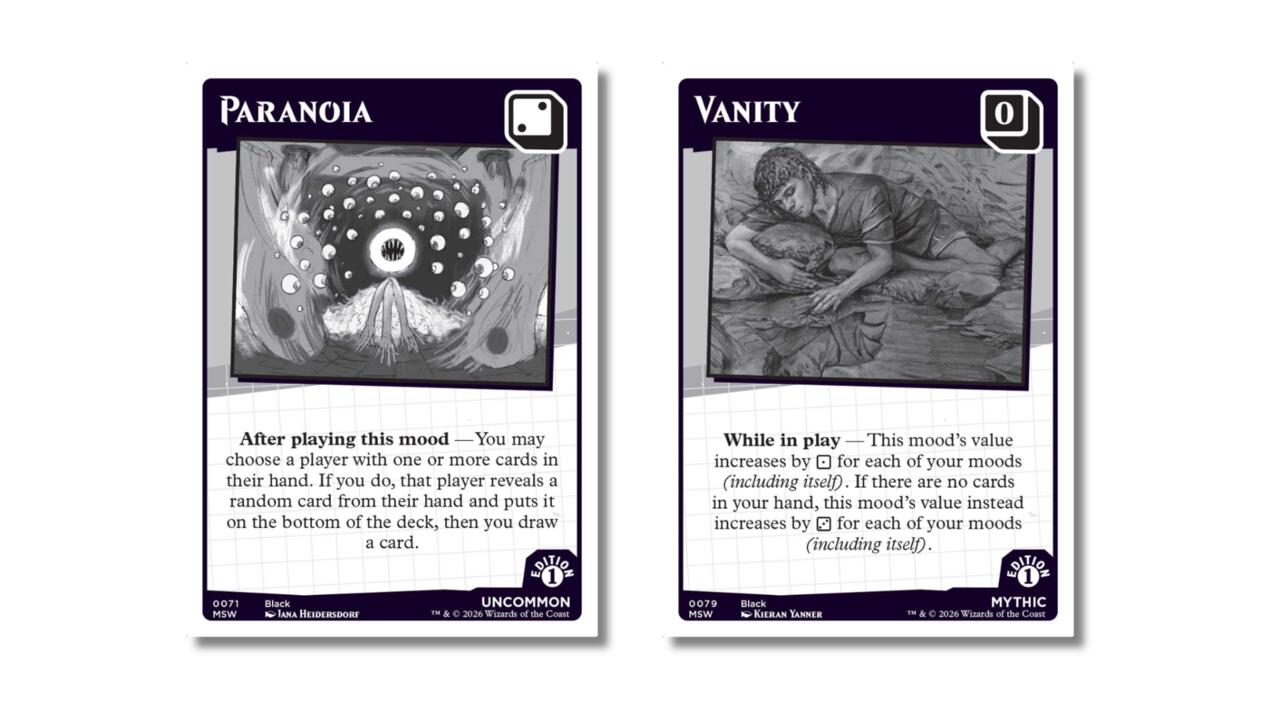
It’s the final round, with myself and Rosewater tied at 2 rounds a piece. As he begins to explain the series of moves that he wants to pull off, he comes to realize that it’s not actually going to go the way he thought. You see, Rosewater already has Vanity in play, which has a starting value of zero, but increases by one for every card (mood) he has on the board, including itself. However, if his hand is empty, Vanity instead boosts itself by three for every mood he has in play.
Rosewater has two remaining cards in his hand, one of which is Paranoia. While Paranoia is only worth two, when played, he can pick any player to put a random card from their hand on the bottom of the deck. While typically one might want to target an opponent with this card, in this specific instance, Rosewater wants to play it on himself, as it would get rid of the other remaining card in his hand. Without that card in hand, Vanity would offer three points per mood he has in play rather than just one.

In the nearly-three decades that Magic’s head designer has been working on Mood Swings, he has never had a reason to target himself with Paranoia. However, the card also forces the target to draw another card, meaning that Rosewater’s hand would not actually be empty once his turn is complete. Vanity’s boost, then, would remain at one per mood in play. “I was so excited,” he exclaims as his strategy fizzles out.
Rosewater plays Glee as an alternative, which is worth six in the round it is played, but is valued at zero in subsequent rounds. Considering this is the final round, it’s a pretty good substitute, and his score shoots up to 23. I look at my hand. I don’t see anything that could turn the tide in my favor. Rosewater explains that my best chance at winning is getting rid of Arrogance, which he played in a previous round, allowing him to steal Loyalty from me. Loyalty is typically valued at three, but is worth six if there are two or more green and/or blue moods on the board, which there are. If Arrogance is knocked out, Loyalty reverts back to me.
However, I don’t have anything in my hand that could accomplish that goal, nor does it seem that I have any alternative paths to victory, so the round, and the game, goes to Rosewater. Considering we had only started playing about five minutes prior to this moment--plus the fact that Rosewater had conceived this game when I was only six years old--the sting of defeat was more of a very gentle pinch.
While it would require playing Mood Swings numerous times to really get a feel for it, I was surprised at its complexity from the jump. Yes, understanding what is needed for victory is straightforward and its round-based structure means that games should be over relatively quickly, but the different synergies that you can accomplish with its cards are far closer to the depth of the game’s veteran sibling, Magic The Gathering. Much like in Magic, I pulled a couple of cards that required me to reread their effects numerous times to understand them, and even then, I felt like I wouldn’t truly know how they worked until they were played.

This might sound antithetical to the intention of Mood Swings, but I think it nicely straddles the line of simplicity and complexity. As trite as the phrase “easy to learn, difficult to master” can be, it does sum up my time with the game nicely. At launch, there’s only one Mood Swings product available: a deck of 45 cards. However, there are a total of 133 cards those decks can be constructed from, meaning the likelihood of two deck boxes being identical is near zero. Rosewater wants the game to work if you only buy one deck, but also for there to be enough of a hook for a percentage of players to be enticed into acquiring more. There’s also potential for other products to be introduced down the line, such as booster packs, and Rosewater has a list of over 500 emotions put together for possible cards in the future, but all of that will likely depend on how successful Mood Swings is out of the gate.
While Rosewater tries to remain Detached as he talks about a potential future where he and the team don’t get to develop more cards, telling me they’ve done all they can to make it a success, the quiver in his voice betrays his true emotion: Yearning. It’s incredibly clear that Rosewater deeply desires his long-gestating trading card game to be a hit. Mechanically, it feels like it could be, as after my very limited time with the game, I’m in the mood for more Mood Swings.
Mood Swings will be available starting June 1st through Secret Lair, each deck priced at $25 dollars.
